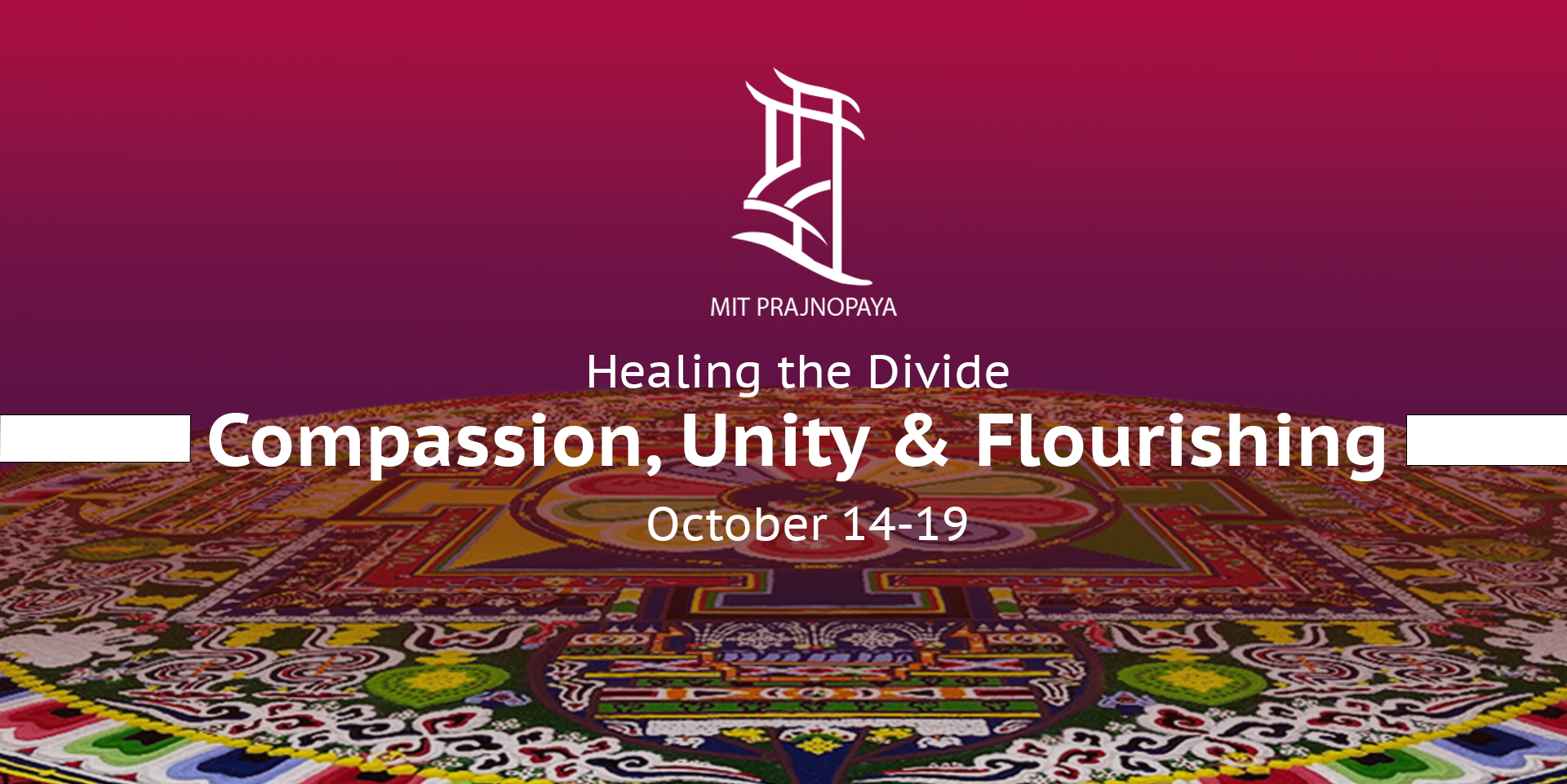
October 14-19, 2025
Venue: MIT Simmons Hall MPR (229 Vassar St.)
Tentative Schedule:
October 14: Sand Mandala Construction Commences
October 16 at 6:30PM: Prayers for Healing and Peace
October 17 at 6:30PM: Special Screening: Wisdom of Happiness (Bldg 3, Room 333)
(Public viewing hours: 11AM-3PM and 4PM-6:30PM. Please bring a MIT ID or Government Issued ID to access)
10AM-1PM: A Retreat on Cultivating Patience with
Venerables Gyabung Rinpoche + Tenzin Priyadarshi Rinpoche
3PM-4PM: White Tara Long Life Ceremony
4PM: Closing Prayers & Mandala Dissolution Ceremony
(all are welcome to participate in the dissolution ceremony)
Thank YOU for making 2025 Sand Mandala a vibrant and meaningful event!
What is a Sand Mandala?
The Tibetan culture is one of the most ancient on our planet and is currently highly endangered. Among the Tibetan arts, the practice of creating Mandalas by painting with colored sands through funnel- like tubes, remains as one of the most uniquely exquisite and deeply symbolic. This sacred art form is constructed as a vehicle which generates compassion to benefit all beings, manifests healing energies in the environment and a serves as a reminder of the impermanence of the physical world.
The art of making sand mandalas is not only found in Tibetan and Eastern spiritual traditions, but also appears in many Native American cultures. Legend has it that most traditional or sacred patterns used as a basis for the creation of sand mandalas appeared as a “vision” in the mind of realized meditation masters. These visionary patterns were then documented with “keys” to interpret the layered meanings contained in the symbols and colors.
Over a period of several days, in a purified site, millions of grains of fine sand, ground from marble and other colored stones, are painstakingly laid into place by specially trained monastics, onto a flat platform, forming an intricate geometric diagram symbolizing the enlightened mind and the ideal world. When the sand Mandala is completed, the colored sands are swept up during a dissolution ceremony and poured into a nearby river or stream. From there, the waters carry the Mandala’s blessings and healing energies throughout the world.
The Mandala Project: Aesthetics, Contemplation, and Education is a visionary and meditative exercise that can encourage young minds to “visualize” and contemplate the positive qualities they would like to see manifested in the world around them. This pedagogical tool encourages participants to reflect and conceptualize during a collaborative process making an abstract creation that represents a better world.